Know your block’s risks before you buy or build.
Is your property in a bushfire zone, a noise corridor, or a potential flood plain? What's the average new build cost in your area, and how many building permits have recently been issued?
Within 48 hours, a build intel report answers these questions and many more — giving you everything you need to know before you buy or build your new home.
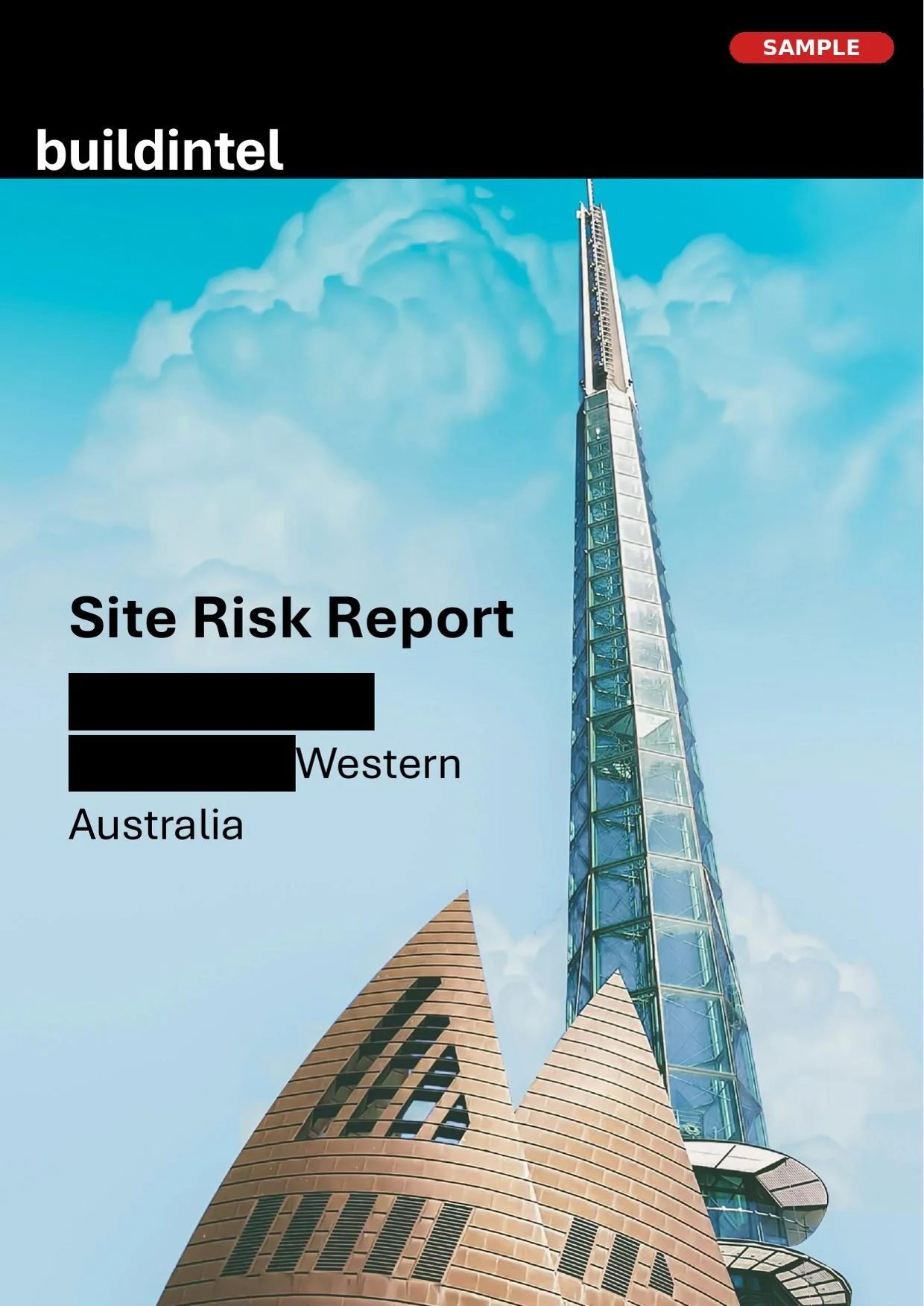
Know the risks before you commit.
The build intel. Site Risk Assessment is a detailed, address-specific report on the building risks and attributes of any Western Australian property — whether you're buying an existing home or a block to build on.
For $149, delivered within 48 hours, we analyse 20+ risks and attributes for your exact site, including bushfire and flood risk, groundwater, ground and geological conditions, contaminated-site proximity, coastal erosion, corrosion, noise exposure, cyclone exposure, climate-zone considerations, site elevation and slope, how your build cost compares with your local area, your build's projected duration, and local building activity.
Why it matters. These risks can limit what you're able to build, drive up construction costs, and reduce a property's amenity if they aren't considered early. Our report identifies them and explains their impact in plain English — so you can buy or build with your eyes open and avoid surprises that can cost tens of thousands later.
What you get. A professional PDF report covering 20+ risk categories with a clear explanations of what each finding means for your project.
How it works.
Enter your property address.
We analyse your site against 20+ risk datasets.
Your report arrives within 48 hours.
Western Australia only · $149 · delivered within 48 hours.
How it Works
Three steps from address to answers
01
Enter your address
Type your Western Australian property address and pick it from the list. That's all we need to start.
02
We run the checks
Bushfire, flood, groundwater, ground conditions, noise, build cost and more, drawn from official government datasets for your exact site.
03
Your report arrives
A plain-English PDF with every risk rated, in your inbox within 48 hours.
What your Perth & Western Australian property site report covers
Using public databases and our own proprietary tools, we complete a desktop study of your site, considering 20+ risks and attributes, including:
Your sites elevation and slope
If you’re in a bush fire area
The likelihood of a flood event
Impact of groundwater to your site
Local geological and ground conditions
Your proximity to a known contaminated site
The likelihood of coastal erosion
Increased corrosion risk
Noise exposure
Cyclone exposure
What to consider when building in your climate zone
How your build cost compares with your local area
Your builds projected duration
Building volume in your area & proximity to future State developments
These risks — and many others — can limit what you're able to build, drive up construction costs, and reduce a property's amenity if they aren't considered early. The build intel report identifies these risks and explains their impact, so you can avoid unwanted surprises.
A build intel report isn't a substitute for a building inspection or town-planning advice, but it's a strong first step toward understanding the challenges and risks that may affect your property before you buy or build.
Know the risks before you commit.
The build intel. Site Risk Assessment is a detailed, address-specific report on the building risks and attributes of any Western Australian property — whether you're buying an existing home or a block to build on.
For $149, delivered within 48 hours, we analyse 20+ risks and attributes for your exact site, including bushfire and flood risk, groundwater, ground and geological conditions, contaminated-site proximity, coastal erosion, corrosion, noise exposure, cyclone exposure, climate-zone considerations, site elevation and slope, how your build cost compares with your local area, your build's projected duration, and local building activity.
Why it matters. These risks can limit what you're able to build, drive up construction costs, and reduce a property's amenity if they aren't considered early. Our report identifies them and explains their impact in plain English — so you can buy or build with your eyes open and avoid surprises that can cost tens of thousands later.
What you get. A professional PDF report covering 20+ risk categories with a clear explanations of what each finding means for your project.
How it works.
Enter your property address.
We analyse your site against 20+ risk datasets.
Your report arrives within 48 hours.
Western Australia only · $149 · delivered within 48 hours.
Frequently asked questions
-
Federal, state and local government regulations are always changing — a house built 50, 20 or even 2 years ago may not meet today's requirements. Knowing whether a property is subject to certain risks helps you ask the right questions and check that it meets current standards.
-
Regulations change constantly, and their impact is unique to every block. Understanding a property's risks before you buy can save you tens of thousands in unwanted surprises later. The report won't change your block's risk profile, but you'll go into the purchase with your eyes open to its risks and limitations.
-
Not always — it depends on the severity. A block that slopes less than 3% is fairly flat, while a slope over 10% can be significant and affect things like where you put a driveway. Any slope across your block over 15% can greatly limit what and how you build, and significantly increases construction costs.
-
Yes. Building in a bushfire-prone area can mean higher insurance premiums, local-government requirements for managing vegetation, provision for fire-control items, and additional National Construction Code (NCC) requirements.
What about new builds? The NCC mandates additional construction requirements for homes built or substantially renovated within a bushfire zone. Not all bushfire zones are equal — each property is assigned a Bushfire Attack Level (BAL) depending on its characteristics and surroundings. A BAL assessment is usually required by the local government before a building permit is issued, and it's best to get one as early in the design process as possible.
-
Substantial parts of the Perth and Mandurah area fall within flood zones. The WA Government identifies areas potentially affected by flooding and assigns a probability (expressed as 1-in-X years) — some areas are as high as 1-in-5-year, others 1-in-100-year or no discernible risk. In high-probability areas you may need extra civil works to raise the site level, or a different construction method (such as a suspended slab, foundations supported by piles, or a house on stilts) so floodwater doesn't enter the home. The NCC or your certifying engineer may also require specific measures.
Already in a flood zone? It's not too late — drainage improvements like channel drains, soak wells, retaining walls and landscaping can help direct water away from the property and into stormwater systems.
-
In short, yes. Older homes in particular often weren't built to block rail, road and air-traffic noise to modern standards — which can require thicker windows, extra insulation, solid walls as noise barriers, and changes to building orientation to limit noise in living areas.
What about a new home? New homes in noise areas face additional NCC, state and local requirements and are typically more expensive to build. There are different levels of noise exposure — our report tells you your property's level so you understand the impact.
-
There's no single right answer, but it's often wise to build consistent with the surrounding area so you don't under or over capitalise. If you're building to sell, a home that fits the neighbourhood is more likely to be valued fairly. Our report shows what people are spending to build new houses in your area — including the lowest and highest-cost builds — so you can see how your spend compares with your neighbours.
-
The Master Builders Association noted in 2024 that Western Australia is the slowest state in Australia to build a new home. Every build differs, but around 18 months from approval is the current WA average. Using the information you provide, our report generates an indicative full timeline — from design and approvals through construction to occupation.
-
No — ground conditions vary a lot across Perth, and they directly affect how, and how much, you can build. The Swan Coastal Plain ranges from free-draining Bassendean and Spearwood sands to Tamala limestone near the coast and reactive clays along the river flats and Darling Scarp foothills. Your soil type drives your site classification, which sets the footing and slab design you'll need. Stable sand or rock is cheapest to build on; reactive clay moves with moisture and needs stiffened slabs or piering — adding cost if it's missed. A soil test is required before building, and our report gives you an early read on likely ground conditions.
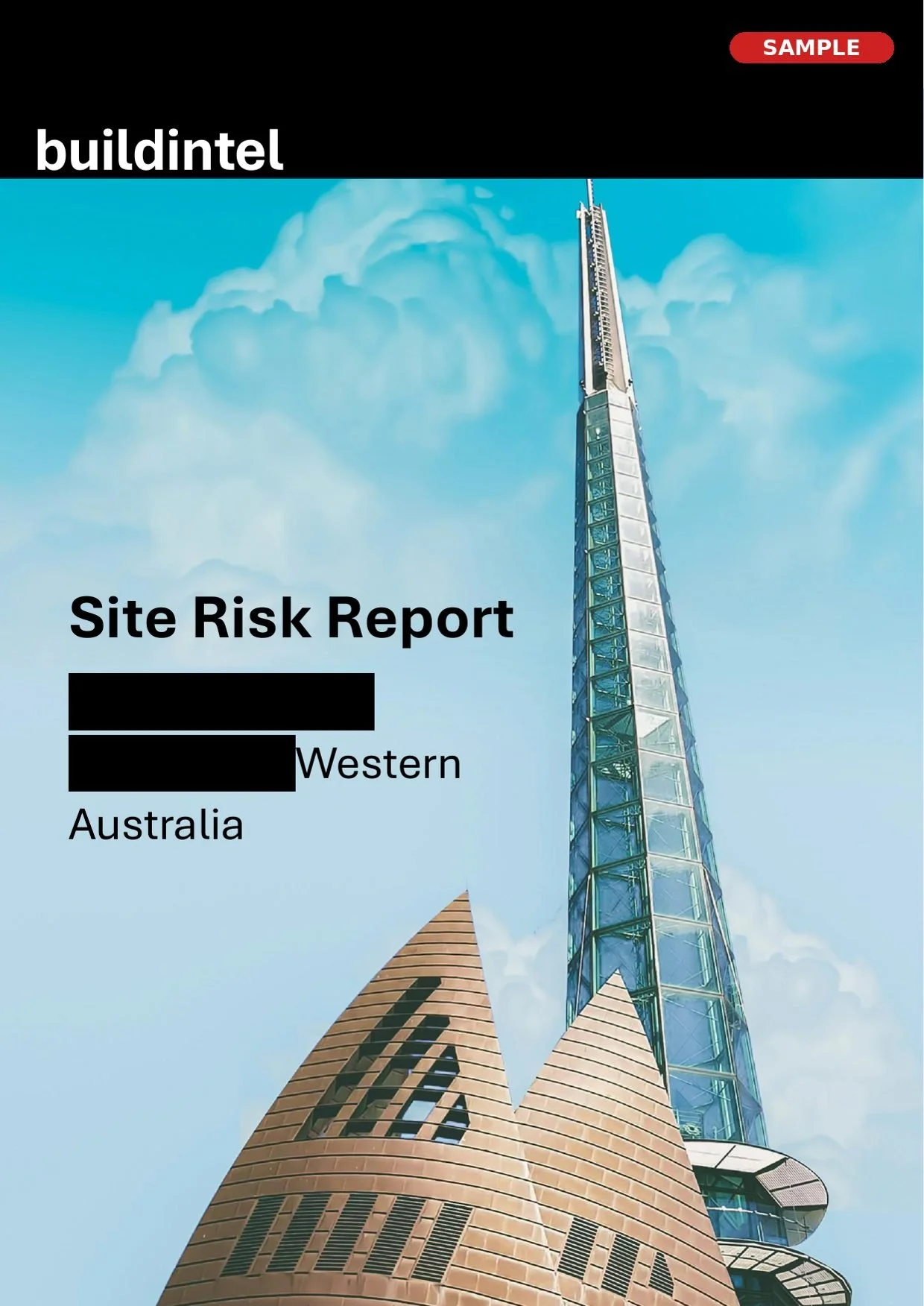
Know the risks before you commit.
The build intel. Site Risk Assessment is a detailed, address-specific report on the building risks and attributes of any Western Australian property — whether you're buying an existing home or a block to build on.
For $149, delivered within 48 hours, we analyse 20+ risks and attributes for your exact site, including bushfire and flood risk, groundwater, ground and geological conditions, contaminated-site proximity, coastal erosion, corrosion, noise exposure, cyclone exposure, climate-zone considerations, site elevation and slope, how your build cost compares with your local area, your build's projected duration, and local building activity.
Why it matters. These risks can limit what you're able to build, drive up construction costs, and reduce a property's amenity if they aren't considered early. Our report identifies them and explains their impact in plain English — so you can buy or build with your eyes open and avoid surprises that can cost tens of thousands later.
What you get. A professional PDF report covering 20+ risk categories with a clear explanations of what each finding means for your project.
How it works.
Enter your property address.
We analyse your site against 20+ risk datasets.
Your report arrives within 48 hours.
Western Australia only · $149 · delivered within 48 hours.